

James Eyers Senior Reporter
Feb 8, 2026
Australian banks and super funds are taking their first tentative steps in the use of stablecoins, deploying the digital currency in trial capital market transactions to speed up settlement times and reduce costs.
Offshore, stablecoins are increasingly being used for payments – forcing banks to take notice amid industry concerns they may soon become an alternative venue for retail deposits.
Stablecoins present a threat to bank deposits, according to Jarden. Getty
As the name suggests, stablecoins are a less volatile version of cryptocurrency because their value is pegged to a hard currency, such as the US or Australian dollar. The global market has more than doubled over the past two years to $US315 billion ($448 billion), and US Treasury Secretary Scott Bessent predicts the value of stablecoins will grow tenfold to $US3 trillion by the end of the decade.
Fintechs, including Block’s Cash App and Revolut, are integrating USDC, the second-largest US dollar stablecoin, to allow users to pay with it. Stripe, another global fintech popular with merchants, allows stablecoin payments, while Visa and Mastercard are integrating stablecoin settlement into their global networks.
Investors in Australian banks should be paying attention, Jarden analyst Matthew Wilson said. In a series of recent research notes, he warned the emergence of stablecoins presents a big risk to bank deposits, suggesting the sector may be in the early stages of a “Kodak moment”.
“Money may no longer be confined to banks; it can now move freely through a digital ecosystem outside the traditional financial system,” Wilson said.
Joseph Cox, a partner at consulting firm Oliver Wyman, said the Trump administration’s supportive policy is forcing banks and regulators all over the world to prepare for stablecoins becoming more mainstream. Until late last year, he led the US Federal Reserve team regulating banks engaged in crypto and fintech, and was in Sydney recently to brief Australian banks and the Reserve Bank on global developments.
“It was feasible, a few years ago, to adopt a wait-and-see approach, but increasingly banks and regulators will have to work out what their strategy is, given how fast things are moving,” he said.
Acacia pilots
In Australia, the corporate regulator licensed the first Australian dollar stablecoins late last year. They are not yet being used for retail payments but have been used in a series of pilot transactions as part of Project Acacia – a joint research project between the Reserve Bank of Australia and the Digital Finance Cooperative Research Centre.
Payments in stablecoin allowed a series of complex debt transactions to be completed almost instantly. At the same time, products were swapped between counterparties, a concept known as ‘atomic settlement’. In one of the trials, an Australian dollar stablecoin issued by ASX-listed Cuscal was used to buy a debt instrument issued by the Bank of Queensland.
Using Imperium Markets, a digital marketplace, Challenger bought the debt off AustralianSuper. The super fund then used the stablecoin to buy a term deposit “tokenised” by National Australia Bank and Westpac. Tokenisation refers to the process of creating a digital representation of an asset that can be stored on a blockchain system.
Participants said the deal settled in minutes compared to around a day under existing processes. Cuscal managing director Craig Kennedy said the trial demonstrated the value of settling transactions with stablecoins. “The pace of this trial settlement underpins the ability of this initiative to unlock new opportunities for Australia’s economy,” he said.
Imperium Markets has also facilitated the first “tokenised” corporate bond transaction in Australia as part of the Acacia trials. This used the AUDM stablecoin, issued by Macropod, a joint venture with Mark Carnegie’s crypto group. The bond was purchased by Barrenjoey, which executed a secondary trade to JellyC, a digital asset management company.
“We need to make sure Australia is ready for what is an inevitable transition to tokenised markets,” said Macropod chief executive Drew Bradford, a former NAB banker.
As stablecoins are adopted beyond the wholesale markets and integrated into retail digital wallets, some analysts and bank bosses are sounding the alarm about their potential to disrupt the financial services industry.
Citi analyst Ronit Ghose pointed to a possible flight from bank deposits similar to when money market funds were created in the 1980s. Bank of America chief executive Brian Moynihan said last month that yield-bearing stablecoins could see $US6 trillion of deposits leaving US commercial banks.
Most global jurisdictions with regulated stablecoins – including Europe, Hong Kong, Singapore and the United States – restrict issuers from paying interest. That serves as an impediment to them rivalling retail deposits. However, the arrangement could be under threat.
Backed by US President Donald Trump, the US last year passed the GENIUS Act, creating the first federal regulatory system for stablecoins. But US banks are concerned about what they see as a loophole in the law, allowing parties that use stablecoins to offer “rewards” to holders.
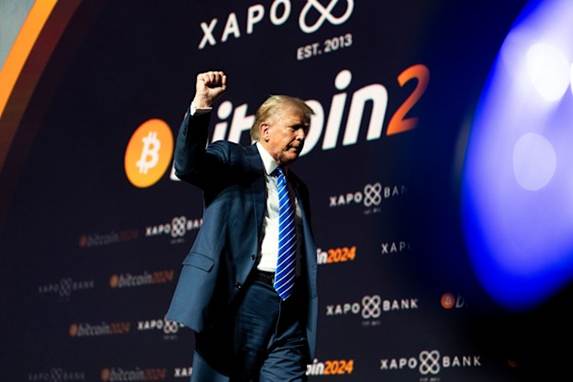
US President Donald Trump has been a big supporter of crypto including legislating the GENIUS Act. The New York Times
In Australia, Treasury is developing digital asset legislation to regulate stablecoins, with regulator APRA likely to be given oversight powers.
In a report released at the World Economic Forum in Davos last month, Oliver Wyman said stablecoins would grow substantially in the years ahead, “putting pressure on bank funding and payment fees, but also providing banks with substantial revenue opportunities via blockchain transactions, conversion, and foreign exchange fees”.
Jarden’s Wilson said stablecoins will challenge banks. “The traditional bank is highly regulated because it is highly geared and significantly funded by at-call, no or low-cost retail deposits, creating material liquidity risk,” he said.
“However, a stablecoin system backed by a diversified portfolio of sovereign debt, appears more ‘anti-fragile’ … It’s not a solution looking for a problem: it might be a genuine advancement that builds a safer, more efficient system.”